(From the unpublished ‘K444 – Growing Up In The Shadow of a Rusty Boat’)

Childhood is made up of exploring our senses; tasting everything with an eye to disliking it, touching objects to learn their density, hardness, warmth or cold, watching pets and older siblings to mimic them, listening for the first raindrops in a Summer storm.
But the greatest sense of childhood is smell; the smell of fresh baked bread on Saturday morning, rice pudding or blackberry pie just from the oven, roast turkey being sliced for Christmas dinner. And these remembered smells follow you throughout your life, evoking quiet smiles in the oddest places.
I remember once walking through the street market in Ismailia past a cabinetry shop. There on shelves were rows and rows of fragrant boxes – pine, Lebanese cedar, mahogany and sandalwood, redolent in the hot, fetid summer air, a clinging mix of fragrances punctuated by shisha from the street. And in that moment my memories transported me back in time to Clary’s workshop.
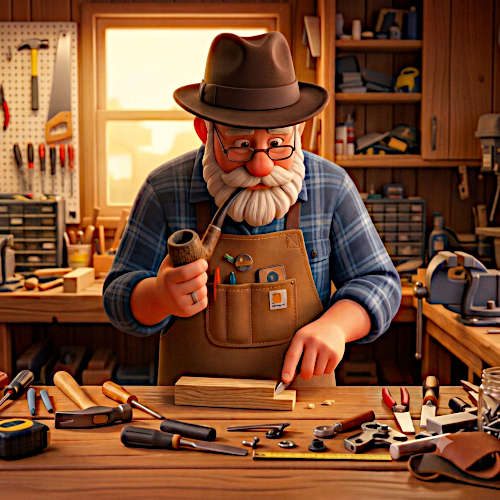
Clare Baker was an old friend of my Father, long past retirement, but still ‘putting in an honest days work’ in his woodshop tucked beneath the tidy domain of his wife Jean. Amongst the piles of shavings and sometimes still smouldering pipes could be found armoires, bedside and dining tables, mahogany chairs just waiting for a final coat of varnish, whatever project Clary had on the go. And each piece of furniture with the loving touch of a craftsman.
Like my Father, Clary was old school, just a large ancient table saw in one corner of his shop. But the walls were lined with pegboards groaning under the weight of every hand tool imaginable. Keen edged planes, handsaws of all types, hammers from tiny to almost too heavy for me to lift. And like the pieces they produced all maintained in immaculate condition.
When I was small my Father would have me wait by the door as he conducted whatever business he had with Clary (or simply shot the breeze if the mood was on them), but from my vantage point I watched intently. Every board he touched was sighted down for warp, wind or cupping, every measurement done twice and sometimes thrice, every stroke of his brush calculated not to leave a streak or brushmark.
Clary was in a word, a master. It was the only way he knew how to work. And it amazed me that this wee man with the hunched shoulders, chronic smokers cough and gnarled, arthritic fingers could make such a fine dovetail that it didn’t need glue to sit square, tight and proud. Even my Father, an expert millwright and no slouch at making furniture would crouch down to admire Clary’s work.
As I grew older my trips to his shop became less and less, save the few times I would accompany my Father on his trips north to Campbell River. But each time I would be greeted like a long lost friend, or fraternity brother who has been on some extended business trip. And each time Clary would have something new for me to see, explaining in detail how he achieved a certain finish or why a box joint would suffice when I clearly thought a dovetail was in order. And always stressing the superiority of hand tools.
I stopped in front of the shop and ducked inside, breathing in great drafts of the wood smell. Under the watchful eye of the proprietor I turned over several of the boxes, running my fingers along the bottom seams, looking for voids or splinters, the telltale signs of mass production, possibly in the Orient. But there were none, each seam a single tight line, equal and firmly attached. I smiled and commended the proprietor on the craftsmanship. He smiled in return and bowed slightly, pointing towards the back of the store where I could just see into a cluttered workshop with sawdust covering the floor.
Clary would be proud.
(original image by Dormeur74 @ pixabay.com)